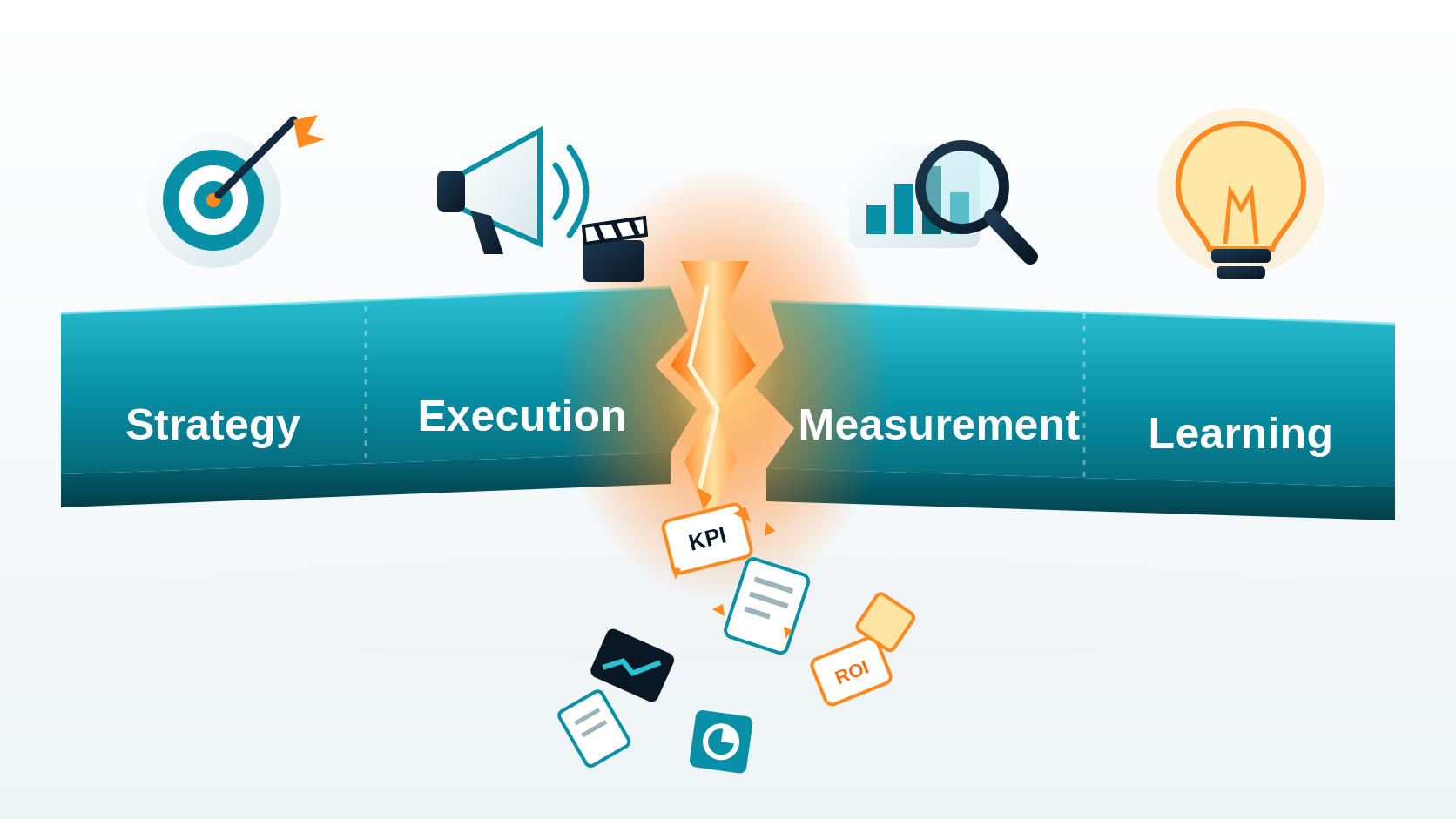
A campaign can be ready to launch while the marketing process behind it is not.
The agency has delivered the assets. The media team has set up the campaigns. The landing page works. Someone has checked the tracking dashboard. On the project board, every task is marked complete.
Then a marketing leader asks three questions: Which business outcome are we changing? Will our measurement tell us whether we changed it? Who has the authority to stop spending if the answer is no?
The answers are scattered across teams, systems and documents. The problem is not another missing item on a launch checklist. It is a breakdown in how marketing decisions travel from strategy to execution and back to learning.
Business objective
Business KPI lost
Campaign planning
Fragmented approvals
Execution
Measurement
No decision memory
Decision and learning
Campaign launch is the middle of a process, not the beginning
A campaign is one visible output of a much larger marketing operating process:
Business priority → Marketing plan → Audience and offer → Creative and media → Measurement and permissions → Launch decision → Results and learning.
Every handoff should carry forward the reason for the work, the evidence needed to judge it and the person accountable for what happens next. In practice, information often moves less reliably than deliverables. A team receives an approved brief but not the assumptions behind it. Another team inherits a KPI name but not its definition. A third team sees a launch date but not the condition under which the launch should be stopped.
This is a process-efficiency problem. Work can be completed on time while the marketing organization loses time reconciling interpretations, reopening approvals, rebuilding context and making decisions on incomplete evidence.
A campaign that passes platform checks may therefore still be unready as a business decision.
Where the process breaks
1. Strategy becomes a brief, but the business decision gets diluted
A marketing objective might be to acquire profitable new customers. During planning, that becomes a campaign target. By the time media is activated, the target may be expressed as an optimization event called “purchase.”
Those are not automatically the same thing. A purchase event may include returning customers, and a platform conversion metric does not by itself establish incremental profit.
The failure happens at the handoff: the team has preserved the task but not the original decision criterion. The dashboard can turn green even when the business question remains unanswered.
2. Teams approve their own deliverables, but nobody approves the whole decision
Creative signs off the assets. Media signs off the targeting and budget settings. Analytics confirms that an event fires. Legal or privacy reviews the relevant requirements.
Each approval matters, but none is necessarily a decision that the combined campaign should run at the proposed scope. Is the offer economically sensible? Do the claims match the landing experience? Are the required permissions documented? Is the evidence good enough to justify the exposure? And who owns the final decision?
Without a shared decision point, the launch date becomes the organizing principle. Missing evidence is handled as a last-minute exception rather than as a condition for spending.
3. Execution produces reports, but the organization forgets what it decided
Once the campaign is live, teams monitor their own systems. Performance reporting may follow platform attribution, CRM outcomes and financial measures that answer different questions.
If the team did not record the initial hypothesis, assumptions, evidence limits and stop conditions, it is difficult to distinguish a changed environment from a flawed original decision. The next campaign begins with another round of meetings and reconstruction.
The inefficiency is cumulative: marketing repeats decisions because it has not preserved the reasoning that produced them.
A concrete example: a campaign that looks ready
Illustrative scenario, not observed company data or a market benchmark.
A regional retailer plans a two-week €30,000 campaign. The business objective is contribution from newly acquired customers after discounts and returns. Creative is approved, audiences are configured and the conversion dashboard is operational.
The platform reports purchases. But the team has not shown that its reported event isolates new customers, or that it reconciles with the contribution measure finance will use. Media sees a functioning campaign; analytics sees an event firing; the business owner still cannot judge the intended result.
The right decision is HOLD for the proposed performance launch. Not because the campaign is badly built, but because the measurement handoff has broken the link between the business outcome and the spending decision.
A separate, limited measurement diagnostic might be appropriate—but only as a new decision with its own scope, approvals, cap, learning objective and owner. It is not a way around the original HOLD.
This example illustrates why launch readiness cannot be reduced to a percentage of completed tasks. Ten green checks do not cancel one missing piece of evidence that determines whether spending is justified.
Put one decision gate between preparation and spending
The answer is not to add another approval committee or another dashboard. It is to create a single, evidence-based decision point in the process before committing material spend.
That decision point asks for three things:
Business decision. What outcome are we trying to influence, under what scope and financial exposure? Who can approve, restrict or stop it?
Decision-quality evidence. Which measurement actually answers that business question? What does it not prove? Are the source, denominator, reporting window and essential checks known?
Permission and operational accountability. Have the required privacy, offer and claim reviews been completed for this campaign? Who responds when evidence changes, and what happens if a critical condition is not met?
Only then is the outcome recorded:
- GO when the necessary evidence and approvals support the proposed launch and exposure.
- CONDITIONAL GO only for a genuinely restricted scope, with bounded noncritical gaps, named owners and explicit stop conditions.
- HOLD when a critical condition is missing, spend is not controlled or the decision-maker cannot accept the remaining exposure.
Mandatory permission or safety requirements are never waived by labeling a launch “conditional.”
The purpose of the gate is not bureaucracy. It is to replace fragmented approvals with one clear decision and an inspectable reason.
What changes in a better marketing operating process
A more reliable process connects five capabilities that are often treated separately.
Process Intelligence makes handoffs and missing decision evidence visible before they become launch-day surprises. Company Memory preserves the context, facts, assumptions and source definitions that teams otherwise reconstruct. Judgment tests whether the evidence supports a specific decision, rather than treating every platform signal as equivalent. Governed Action connects approval to bounded execution, monitoring and the conditions for intervention.
After launch, the decision and the observed outcome should return to Decision Memory so that the next campaign can build on what the organization learned.
This is the Olymuse perspective: the goal is not to automate more campaign tasks in isolation. It is to make the marketing process more coherent from objective to action to learning.
Try this on your next campaign
At the next campaign approval meeting, choose a campaign everyone considers ready. Instead of introducing another form, discuss five questions: What business outcome matters? Which evidence can actually measure it? Are the required permissions in place? What exposure are we authorizing? Who can stop the spend?
Record the decision in a few lines: GO, CONDITIONAL GO or HOLD, the reason, any missing evidence, an accountable owner and the point at which the team will revisit it. If a critical condition is absent, resolve it before the proposed launch. The value comes from a shared decision, not from completing another checklist.
Evidence and limits
IAB's cross-channel measurement consultation announcement and public-comment page provide context for matching measurement methods to the business decisions they can support. The public-comment materials are not a validated finding about this retailer or proof of campaign incrementality. The distinction between platform-reported purchases and new-customer contribution in the example is an analytical illustration, not an observed Google Ads result.
The retail example is explicitly synthetic. The process diagnosis and three-part decision gate are an Olymuse editorial interpretation and operating proposal, not a measured industry prevalence or a certification. Specific privacy and legal requirements must be assessed for each campaign.